
On the power of images and of good-enough political initiatives
By Franklin Vaci
“Give me a child for 8 years, and I will transform the world” is a quote often, though erroneously, attributed to Lenin. Some variations on this have Lenin promising a Bolshevik rather than world transformation, and some have him asking for a generation of youth, youth as a class, rather than an individual child.
In any case, whatever the fake quote may be, I contend that one needs none of it to change the world. Not the child, nor the youth-in-plural. Not the eight years. And certainly not the Bolshevism. Instead, I think one can prime an individual to believe anything given the right images, in the right series, and presented in the right way.
Adam Curtis, acclaimed British documentary filmmaker, plies his trade on the same recognition. His films are a series of audio-visual prompts through archive footage, chosen and combined to articulate an essay without words. So too with Johan Grimonprez in his Soundtrack to a Coup D’Etat, which conveys the cynicism of Jim Crow America in sending black musicians to Africa for diplomacy while maintaining a system of racial discrimination at home. He does so without a single bit of exposition. Where on-screen text or narration feature, they serve to cut clips up or introduce themes, rather than to replace footage as the primary instrument of communication. If, by the old cliche, a picture speaks 1000 words, then what might an hour of images or short videos do?
It would perhaps be too naive to reanimate the corpse of Situationism here, but not as naive as dismissing the prophetic claims of Debord and Baudrillard out of hand — we do, in fact, live in the Society of the Spectacle. Our lives are built around images. They frame our access to social life, politics, work, love, ourselves, our friends and enemies, our local beliefs and our international ones. Has it ever struck you as odd that, although the old sites of public engagement (mass parties, trade unions, political associations) are in decline, the “public mood” still maintains ideological coherence? Take the George Floyd protests, for example. One couldn’t say that this explosion of American political energy was the measured product of civic discussion, more than the spontaneous, visceral, grief-like reaction to injustice, fuelled by that now-infamous image of Floyd’s last moments. Likewise, Alan Kurdi, the Syrian baby photographed face down on a Turkish beach, is an image we are unlikely to readily forget.
x.jpg#/media/File:George_Floyd_Memorial_at_Chicago_Avenue_&_38th_Street_(49952803788)x.jpg)
By Fibonacci Blue from Minnesota, USA - File:George_Floyd_Memorial_at_Chicago_Avenue_&_38th_Street_(49952803788).jpg, CC BY-SA 2.0, Link

.jpg)

Powerful images from (left and) right
These were powerful moments in recent history, that power having been produced through the weight and sensual immediacy of the image. But we remember these instances for their political implications precisely because they match our own. Across politics, if there was ever a political movement that understood the power of images, that movement lives on the right. It lives with Trump and meme magic. Left-liberals have long monstered immigration fear in the West as a form of “false consciousness”, that the voting base of the right can be brought back into the fold if only they would focus on the racially-neutral problems of the economy, or civic culture, or political corruption. This strategy has, clearly, proven insufficient.
Why? Because what is disliked about immigration is not its substance, but in its basic aesthetic qualities. It lives in the world of images, and images are not grounded on ideological coherence so much as the provocation of spontaneous emotions superimposed on broader tendencies. Take, for example, a recent trend on UK right wing social media of taking (real, by the way) class photos of schoolchildren in England. Staged in such photos is a white student, juxtaposed against ethnic minority peers. A white viewer is expected to directly or indirectly identify with the only white student, so as to evoke feelings of loneliness and conventional minoritarian fear. The subtext (as I put it, “broader tendency”) is about racial demographic trends: the subject of this image is set to endure, or be reproduced, the country over, forever.
The power of images is such that a viewer might be moved by the image but not by the description of the contents of the image in words. If I sat someone down and simply described that photo without showing it, even someone predisposed to being moved by the photo would awkwardly shuffle away from me and “what am I, some kind of deranged racist?” But presented in an image form, with only light, guiding commentary, it seems to circumvent some of those cultural antibodies we have against racism. Indeed, once this image has been shown across a political community, that emotional reaction may graduate into words, discussions, real political beliefs with propositional structure. When those people now discuss demographic change, they now know what it looks like.
The left have not entered into the world of images in any compelling way, beyond more “artistic”, low-vector means such as short institutional films and feature-length documentaries. AI serves as a great test case because it collapses the barrier. Tally up the political AI visual products of the right against the visual products of the left, one pits an endlessly productive right against, well, not very much. By and large, the left continues to think and operate in words, essays, “zines”. Its audio-visual production is high-brow, paywalled, or overly institutional. If I asked 5 leftists to imagine their enemy or their utopia, I’d be given 7 different answers. Not because the left doesn’t have their enemies, but because there has been no visual consolidation. The image is simply not in the political idiom of the left. It does not feature in the package of political communication. Not part of the fuel.
Entering the world of images
When I was asked to deliver the accompanying video to the Charta 25 campaign, I very nearly declined. I have no real editing skill. My formative years were spent in the world of words, given a childhood aptitude for them. Where my friends would engage in video production, I used to look at the hopelessly complicated process and wonder why I would subject myself to it when ‘I can communicate my meaning much more efficiently in prose’. While I forgive myself for the naivety of my youth, not developing even a novice competency in filmmaking has been my greatest regret.
So I said yes. What was made as a result is, in my estimation, a technically-defective product for the standards I strove for (though I would thank the reader for any disagreement here). But in the end, I’m not sure it matters. The brutality of the present moment is evidenced in the footage I chose, not the way it was combined. Since putting it together, there have been two further ICE killings, a series of new strikes in Ukraine, the “yellow box” murders in Gaza, war in Iran, and endless other bits of footage that could have comfortably lived in the 90 seconds.
For every hare-brained policy he has drooled out, it was only for the footage of the murder of Alex Pretti that President Trump was threatened. And the call came from inside the house, with Republicans demanding a federal investigation into ICE killings. So it stood to reason that, so long as I could keep the viewer halfway engaged with the content I wanted them to see, then the footage itself would be sufficient for the desired effect. In general terms, what I wanted to do was enter into the foray of amateur political video work and offer a striking impression of the degradation of civilisation. If I had written an essay, which is in the realm of my competence, I simply couldn’t hope for the same.
An act of civic participation
I hope that you enjoyed it. But more than that, I hope that I might have inspired you to do the same. The actual editing is reasonably easy with the right tools; CapCut being the most intuitive “full-blooded” video editor, but one could also use Canva. Counterintuitively, what seems to work on the consumer end is a conceptual approach to the video that renders the actual visual content secondary in some way, so as to make an audience more responsive to more dramatic moments. I chose to use Sinnerman by Nina Simone, and cutting video to music is a great strategy which I shamelessly lifted from Soundtrack to a Coup D’Etat. But one can also, for example, use AI video generation tools (such as Sora or Meta) to create something a little more playful and casual. There is a class of AI absurdist video work that takes the most radical extrapolation of a trend in a half-humourous, half-horrific way that exaggerates a real phenomenon. AI’s lack of a “realism” constraint have allowed for the development of this kind of provocation, and the circumstances at hand often carry with them a flavour of the unreal. Times of crisis are nourishment for the ironist.
It is important that the left offers some compensation for the right’s capability to criticise and provoke by video. That democracies are fragile, power is alien, and images are privileged essentially all comes down to a single voyeuristic attitude. The world we inhabit requires, therefore, some balancing of public discourse that recognises the citizen-as-voyeur in the world of images. We ask our neighbours whether they feel in control of their lives as part of the Open Chair Democracy Talks campaigns. Urban asked me the same question recently. The answer is, in short, no. But politics is in some way the last tool we have left to dictate the circumstances within which our lives unfold. I am “political” precisely for the fact that my civic contribution may change my world, and the world of my peers. State power is, for the secular liberal, a God of our own making — an amenable God, that may harm or aid us based on the strength of our contributions to the body politic.
Good enough causes to stand for
Nevertheless, I think we speak of politics as something that happens to us, something that follows its own logic and development, that we merely tinker around the edges. Or, contrary to that, we think of politics as something over which we have direct control: that, by merely making public our political utterances, we are having a democratic impact. The truth is, invariably, something in the middle. Politics is beyond any one person, but it is not beyond the combined efforts of a motivated group.
It may surprise you to know that I am not wholly committed to every single proposition of the IYTT, nor even every ambition of Charta 25, the matter for which I have sacrificed more hours than I care to mention and to which we are addressed. I have work out there, whether at the IYTT or not, which bears my name but remains nonetheless a partial reflection of my personal feelings. Why do I continue to do it? Because the Charta, like some of the other work I mention, is more good than it is bad. One needn’t agree with every single provision to agree with the spirit and general ambition of a work.
And, indeed, my personal belief is that it would be unhealthy to sacrifice your intellectual independence for the greater good. As a good liberal, for example, I believe that democracy ought to be exclusionary in the sense that it is something you earn. For far too long, I have observed political developments which can only arise from the tendency of politicians to lower the tone of politics to the level of the electorate, rather than trusting the electorate to meet those mighty civilisational ideals that vindicate democracy.
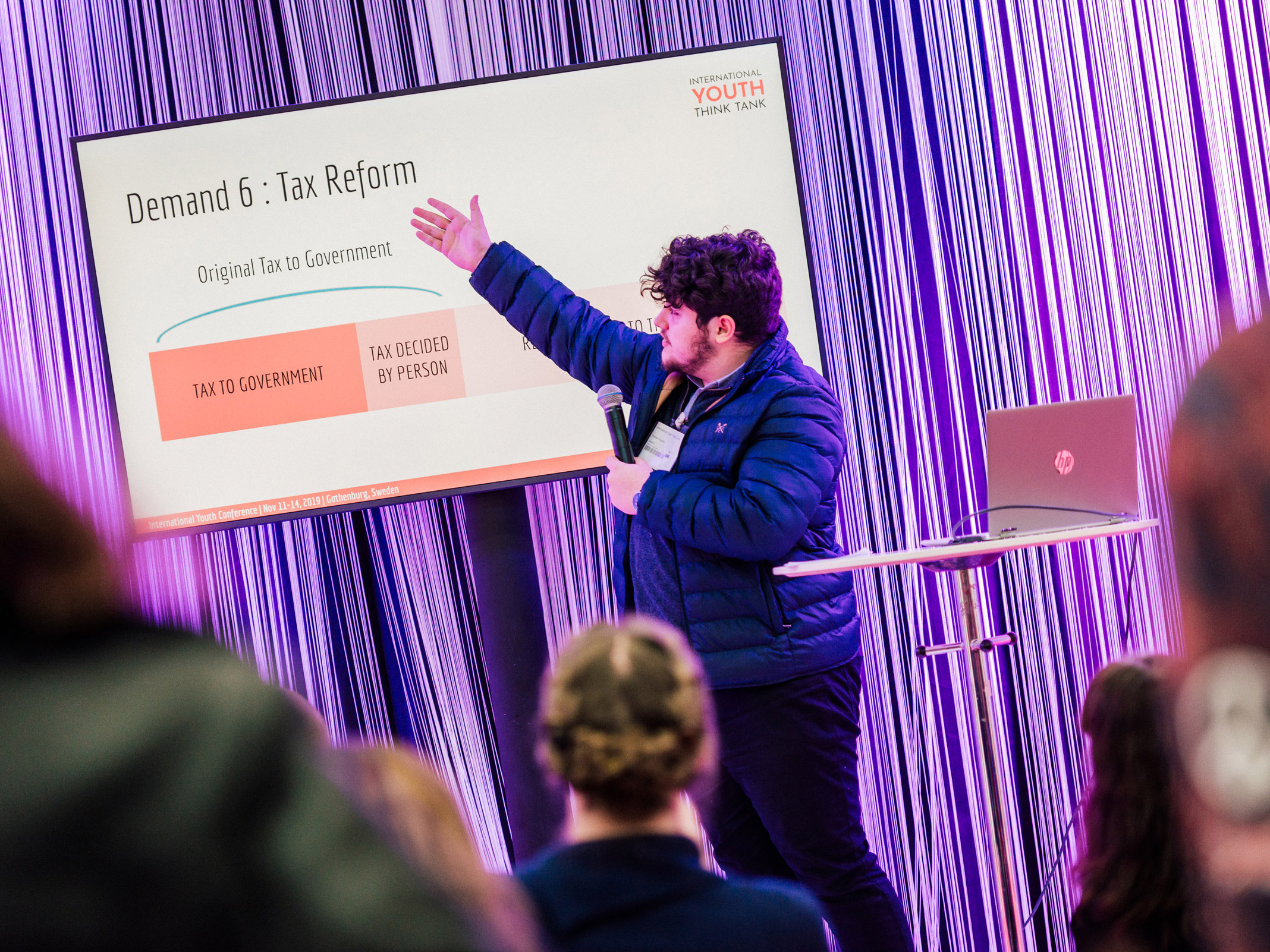
In the inaugural cohort of the IYTTs Youth Fellows programme, I worked on the economics desk. With my peers, we generated a two-pronged approach to public economics as an ameliorative vessel for democracy — one that afforded citizens the basic monetary means of dignity, and one that incentivised them, through fiscal policy, to engage with the society around them. There was something of John Rawls in the approach, which I am still immensely proud of (though, I admit, I had not read Rawls at the time). That, I felt, was much more in keeping with the ambition of an earned democracy, where citizens were asked to and supported in becoming proper democratic subjects. Part of that ambition, to support citizens in contributing to a lively democracy, was carried into Charta.
But while I think I am perhaps unpopular in the intuition that democracy must be earned, I nevertheless agree with the spirit of Provision 8 of the Charta, inasmuch as an exclusionary democracy must not be built on the unjustifiable exclusion of people according to demographic lottery or legitimate dissent. So I will bite my tongue at the phrasing (though we all had an opportunity to contribute), because it is much more important to me that democracy is extended across these demographic or ideological categories than that we embody the ambitions of John Stuart Mill. And, in any case, Provision 1, aptly placed, declares that “Democracy is not a Given”. Quite.
The question is this: does the provocation that Charta poses improve or harm the world? In my opinion, and I am sure in yours too, Charta improves the world. That is why I volunteered to support its development. Authoritative statements of political intention (charters, manifestos and the like) serve as a staging post for political action. They ground you, expose the contents of your heart to the world. This is what we believe. Take it or leave it. In the society of images, to return to the discussion above, what we do is play on basic aesthetic axioms — beauty or ugliness. The human suffering of dictatorial ambitions is ugly, and that ugliness is moving. Why is it ugly? Because that is my intuition. Why is that your intuition? Because, simply, it is degrading to the human spirit, in the way that Charta reveals by force of counterexample.
Atomic steps for the common good
In degrading times, it is nice to have an organisation like the IYTT. A small pocket of relief, that’s always present. Our organisation is different things at different levels. At the most basic, it is a network. I cannot express how privileged I feel to have access to people from all over the world, to discuss global affairs with a youth network across all major global continents, and to keep up to date with the various items they are working on. I spent my last trip to Sweden being shown around Gothenburg by a Syrian-Swedish fellow, who gave me real insight into the racial and economic problems of a country that, in Britain, we take as some kind of gold standard for progressive social democracy. When I offered the youth fellows I met there a sofa to sleep on in London, I really meant it. When I am back in an apartment that has a spare sofa, I extend that same invitation to any fellow reading this.
And I have no reservations about this. Though we may be “strangers” in the formal sense of not having met, I have no reason to doubt that the IYTT has selected, across its 7 year history, for people of good standing. Why? Because the IYTTs project has attracted people that have faith in human goodness, those that are charitable with their time, that continue to dedicate themselves to the project even after they discover that it is not a kind of incubator for a cynical career in politics. In 2019, Urban told us that the IYTT was inspired by his experiences of the Velvet Revolution, where groups of citizens formed (on literal long tables) to discuss what came next in an as-yet undecided future. A revolution may be a stronger tonic for the senses, but we have achieved at least some of the effect without regime change. What comes next?

Franklin Vaci, Youth Fellow
Youth Fellow at the International Youth Think Tank since 2019, Franklin is a writer from London and inaugural youth fellow of the IYTT. He studied philosophy at King’s College London, and currently works in financial services.