
It is my opinion that there is no more vulnerable way to know a person than to watch them go back to a place they once called home. Nostalgia drives so much of our lives and so many of the decisions we make. To be directly confronted by our own nostalgia leaves us nowhere to hide.
I used to feel very negatively about any confrontation with nostalgia, abiding by Steinbecks’s assertion: “You can’t go home again because home has ceased to exist except in the mothballs of memory”, himself expanding on the title of Thomas Wolfe’s seminal work. Nostalgia crippled me, convinced me that all doors that could be opened had been and all those that I could have walked through either wasted or now barricaded, not allowing me that most essential of mercies; a second chance. Everything I wanted lay in a past that existed only in memory.
That feeling still lingers, yet I’ve become more able, and willing, to fight it thanks to two experiences. The first of which was reading a passage in Baldwin’s Giovanni’s Room:
“You will go home and then you will find that home is not home anymore. Then you will really be in trouble. As long as you stay here you can always think: ‘One day I will go home.’”
It’s maybe not the uplifting quote that you were looking for to turn your perception around but that’s what makes it so powerful. It acknowledges what is so hard about leaving a place, what is so hard about moving on from a place, yet it puts to you, in the plainest of terms, what it means to fall into the yearning. The only remedy to the pain of nostalgia is to be stagnant. Between those two options it is a clear choice for me.
The second experience was visiting Oldenburg with Sophia from the IYTT. This was a trip that I had been somewhat unsure about. Planning had fallen through at the last minute for a summer camp we should have been running there and so we were left thinking on our feet for ways to make our time in the city worthwhile. Yet, amongst all our running around between Oldenburg and Bremen trying to remedy the situation, while pulling through Open Chair Democracy Talks with passers-by along the way, the real value of our trip snuck up on me and it was not until I was back home after graduating from my Masters, unemployed and resentful that I realised it.
Originally from Birmingham Sophia had studied in Groningen and done an Erasmus placement in Oldenburg. The week that we spent in Germany she had just finished seeing old friends and old places in the Netherlands and had plans to do much the same whilst in Oldenburg. This is the fantasy of most people I know after doing their Erasmus, including myself; to return to where they had lived so much with the people who had given them so much. For many, it never happens, and for many, it is the greatest reminder that the sparkle of nostalgia is only real in memories, yet to see Sophia living this return and grasping it as much as anyone could hope to was a real privilege. Before going on to hear what Sophia had to say, I’d like to leave you with the most hopeful, and I promise the last, quote about going back home. From Maya Angelou:
“You can never go home again, but the truth is you can never leave home, so it's all right.”
Oldenburg is a place designed to make you nostalgic. It’s hard to imagine many places better catered to a student in their early twenties trying to take a piece of Germany with them. We went to print posters in a student cafe that blended misconstrued americana with iron curtain surliness, spent the evening in a jazz bar where a man in a fedora repeatedly droned Tony Hawk’s name into a microphone made musical by the band behind him, we trapesed over the city to collect camp chairs for our interviews stopping at railway crossings with crowds of bikes ready to hit the gas as soon as the barrier rose. Even I, having never been there before, began to feel the nostalgia. This was spurred on by Sophia’s excitement at accidental meetings with old friends while we shared stories about our respective time spent living away, the city punctuating and acting as a prop for hers.
Rather than me continue to try and describe the experience, then, I think it’s best to let Sophia describe it herself; what the city means and meant to her, what was her experience of going back to a place she called home, and what the whole experience taught her about herself and the world.
J: How would you describe your memories of your time in Oldenburg and how do these memories compare with your feelings whilst you were living there?
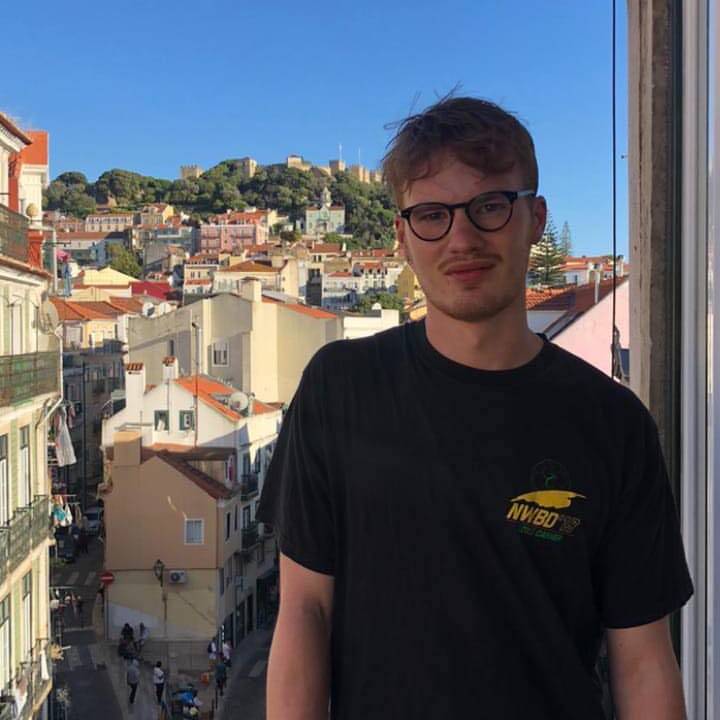

S: My memories of Oldenburg are really positive. It’s quite progressive for such a small city so I felt at home here. It was lovely to be back and to see some familiar faces! I studied here during the winter semester so it was definitely nice to revisit the city in summer. I really enjoyed walking around the green spaces around the back of the Haarentor campus. Finding moments of calm in amongst the nature was really important to me. One of the most unexpected gifts of my time in Oldenburg was how chance encounters with strangers grew into meaningful friendships. So many connections came from simple acts of kindness or curiosity – complimenting a girl at the gym and ending up studying together every week, or admiring someone’s scarf and suddenly finding myself at a flea market with her an hour later. She later came to visit me in England, which still feels surreal given how casually we first met. Those winter evenings spent drinking Glühwein in my friend’s flat, talking about everything and nothing, also became the foundation for friendships that have carried far beyond Oldenburg. We’ve reunited in Birmingham, Berlin and London!
J: What did your time in Oldenburg teach you about yourself? What did it teach you about the world?
S: Oldenburg taught me about the importance of slowing down! My weekends are often packed with endless lists of things to do so I initially found the stillness almost unsettling. It felt wrong that all the shops were closed! But over time, those slow Sundays became one of my favourite parts of living there. They forced me to be fully present and I spent my Sundays taking long walks through the Schlossgarten and lingering over coffee with friends because there was nowhere else to be. It transformed what rest means to me and I miss it! It was also really interesting studying history and philosophy because I learned to communicate even when I wasn’t confident. I actually enjoyed being pushed out of my comfort zone, even though it was scary at the time.
J: How did it feel returning to Oldenburg, did it live up to your memories?
S: It’s always weird going back to visit a place you once lived. I felt a weird mix of nostalgia, but also a sense of excitement at getting to experience the city in a different season and catching up with old friends. I felt strangely proud of my former self for navigating a new academic system, living alone in winter and trying to find a new routine.
That is ultimately what nostalgia is able to do for us. It’s not just about missing a place and a former life, although those things are unavoidable to an extent, it’s about feeling proud of what the experiences you miss have taught you. It’s about understanding how you’ve grown from an experience, appreciating the experiences you have had and people you have known and knowing they will always stay with you, if not physically but in the ways you see, understand, and appreciate the world.
We live in a political climate nowadays where so much is built on misunderstanding, resentment, and longing for a past that no longer exists. We feel entitled to something that never really existed to begin with and allow this entitlement to drive us to hate and resent those around us. Maybe it’s too grand a thing to hope, but I hope we can all learn from Sophia in a little way. To learn that our past teaches us, helps us grow, and makes us but, and the difference is very subtle, that it doesn’t define us.
Joe Earnshaw
Youth Fellow at the International Youth Think Tank since 2022, Joe Earnshaw is a recent Masters graduate in Politics, Big Data and Quantitative Methods from the University of Warwick’s from which he also holds a BA in Politics and International Studies with French. His research interests centre on regionalism with a particular focus on linguistics, migration, and ideas of belonging in such contexts.
This article relates to the activities of the IYTT in collaboration with the Speak Up | Interreg North Sea Project Co-Funded by the European Union.
